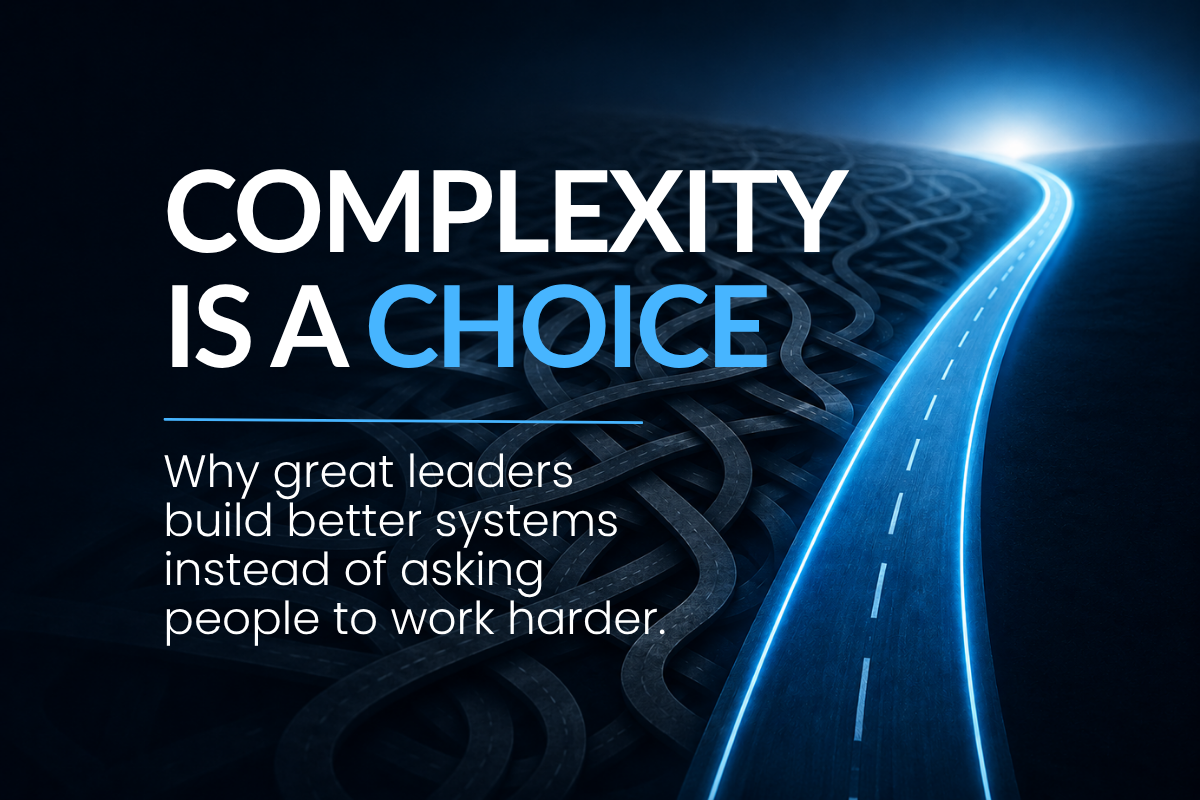
There’s a tendency in business to celebrate the person who saves the day.
The person who stays late to fix the problem. The one who knows the workaround nobody else remembers. The person everyone calls when something breaks because somehow, they always know what to do.
Those people are incredibly valuable. But if the same person has to keep saving the day, there’s probably a bigger question worth asking:
Why does the system keep requiring someone to save it?
I’ve spent a lot of my career building technology, advising organizations and watching teams solve difficult problems. One lesson I keep coming back to is that great people can make almost any process work for a while. That doesn’t mean the process works. And it definitely doesn’t mean it will scale.
Great Businesses Don’t Scale Heroics
Heroics can look a lot like high performance. A talented employee develops a workaround. A technician remembers a configuration everyone else forgot. A project manager catches a problem before it affects the deadline.
The immediate problem gets solved, so everyone moves on. Until it happens again. Over time, those individual saves can become part of how an organization operates. Knowledge stays in people’s heads. Workarounds become processes. Exceptions become normal.
That may work with a small team or a handful of locations. Growth exposes it. When volume increases, you can’t simply multiply your best people. Eventually, the organization has to turn what those people know into something repeatable.
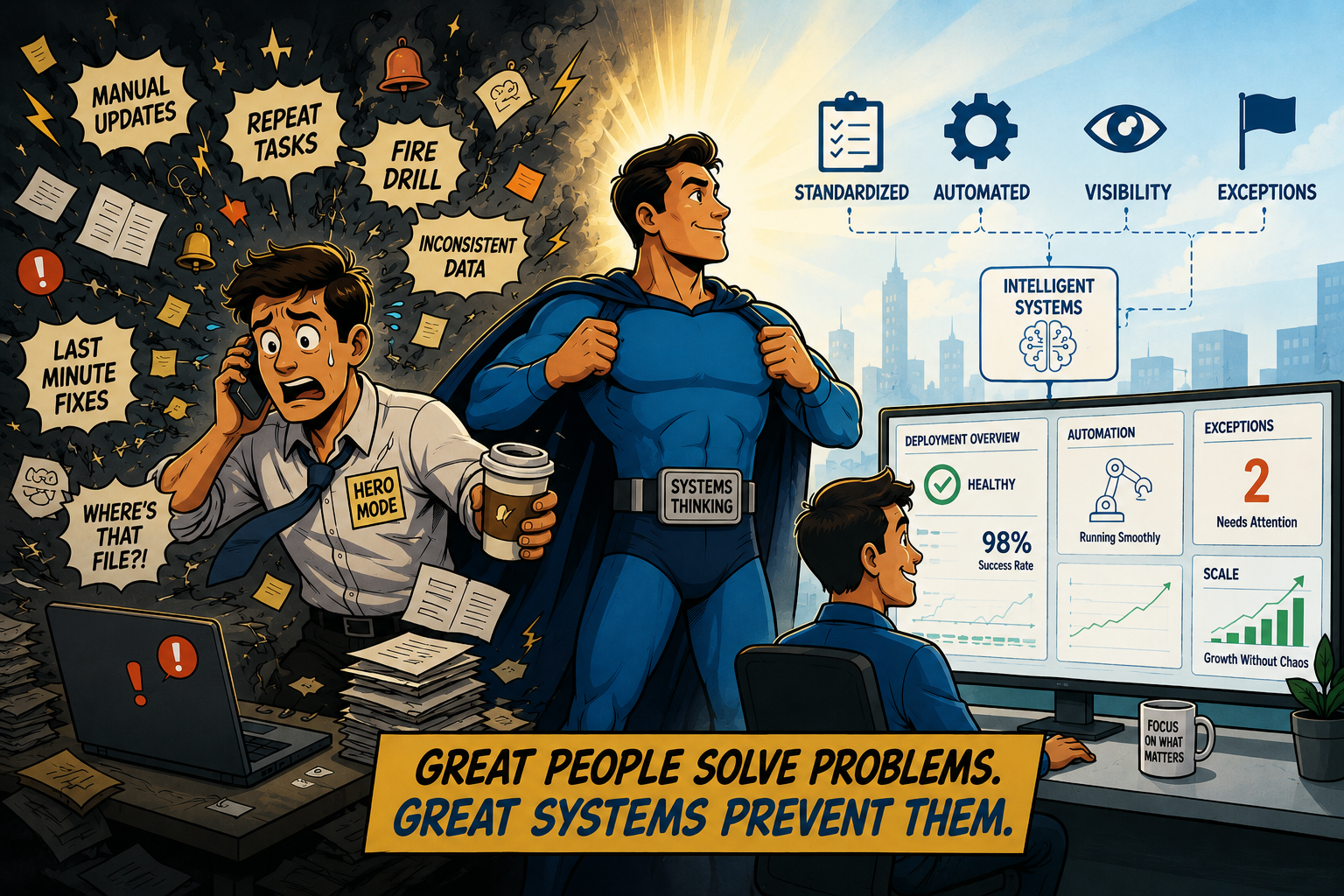
Great systems don’t make great people less important.
They make their knowledge more valuable by allowing it to scale.
Scale Exposes the System
One of the questions I like to ask when evaluating a process is simple: What happens if we multiply this by 10?
Ten times the customers. Ten times the locations. Ten times the transactions. Ten times the devices. If the answer is ten times the people, ten times the manual steps and ten times the decisions, we probably haven’t built a scalable system. We’ve built a process that can get bigger.
Those aren’t the same thing.
A scalable system breaks the relationship between growth and effort. That doesn’t mean effort disappears. It means the same work doesn’t have to be recreated every time volume increases. The question shifts from: How do we do this faster? to Why are we doing this repeatedly at all?
That’s a much more interesting problem.
Automation Isn’t the Destination
Automation is an important part of scale, but I don’t think automation by itself is the end goal. You can automate a poorly designed process and still have a poorly designed process. It just runs faster.
The progression I find more useful looks something like this:
Manual → Standardized → Automated → Intelligent
First, understand the process. Then determine what should be consistent. Automate what is predictable. And eventually, build systems that can use context to determine what should happen next and recognize when something doesn’t fit the expected path.
That’s where technology starts doing more than executing instructions. It starts absorbing complexity. And to me, that’s where things get interesting.
The Exceptions Matter
No matter how good the system is, the real world will find a way to produce something unexpected.
That’s why I don’t think the goal of automation—or AI—is to remove people from every process.
The better question is: Which situations actually need them?
If something happens the same way hundreds of times, it probably shouldn’t require hundreds of individual decisions.
But when something doesn’t fit the expected pattern, that’s exactly where human experience becomes valuable. Judgment. Context. Creativity. Problem solving.
Those are terrible things to waste on work the system already knows how to do. The goal isn’t to automate everything. It’s to automate enough of the known that people can focus on the unknown.
Design the System Before You Scale It
Before scaling a process, I think there are a few questions worth asking:
What should happen the same way every time?
If the answer is known, that knowledge should probably live in the system rather than someone’s memory.
Where are people repeatedly making the same decision?
Repeated decisions are often opportunities for standardization or automation.
Which exceptions genuinely require judgment?
Not every variation needs a human decision.
What knowledge would disappear if one person left tomorrow?
If a critical process lives entirely in someone’s head, that’s a systems problem waiting to surface.
And what happens if we multiply all of this by 10?
That last question tends to reveal a lot.
This Is Also Shaping How We’re Building Optylink
These ideas aren’t theoretical for me. They’re influencing how we think about Optylink. Connected environments are growing quickly, but deploying the devices inside them still involves a surprising amount of repetitive work. Devices have to be identified, configured correctly and aligned with the environment they’re entering. Multiply that across rooms, floors, buildings or entire portfolios, and small manual tasks become a scaling problem.
That’s the problem we’re working on. Instead of treating every device as a new configuration project, we’re designing Optylink around a repeatable deployment model.
Deployment Blueprints define what should happen. The First-Touch Engine identifies devices and applies the appropriate configuration. Scout Intelligence is being developed around coordinating deployment as the environment grows. The larger idea is simple:
Define what is known. Automate what is repeatable. Make the exceptions visible.
We’re still building, learning and refining how these pieces come together. But the philosophy behind them has been clear from the beginning. Deployment shouldn’t become more difficult simply because there is more to deploy.
Scale the System, Not the Effort
The strongest organizations I’ve seen don’t succeed because their people work harder every time the business grows. They get better at deciding what shouldn’t require people’s effort anymore.
They capture knowledge. They standardize what should be consistent. They automate what can be repeated. And they protect people’s time for the problems that actually deserve it.
That’s ultimately what good technology should do. Not create another dashboard to watch. Not introduce another workflow to manage. Not make people faster at performing work that shouldn’t be necessary in the first place.
It should remove work.
Because systems scale. Heroics don’t. And the best technology doesn’t make people less valuable.
It gives their expertise more room to matter.
About the Author
Nathan Neipris
CEO & Co-Founder of Optylink
Nathan is an operations and transformation executive, entrepreneur, and advisor focused on helping organizations navigate complexity, drive growth, and execute large-scale change. Learn more about Nathan on LinkedIn.